
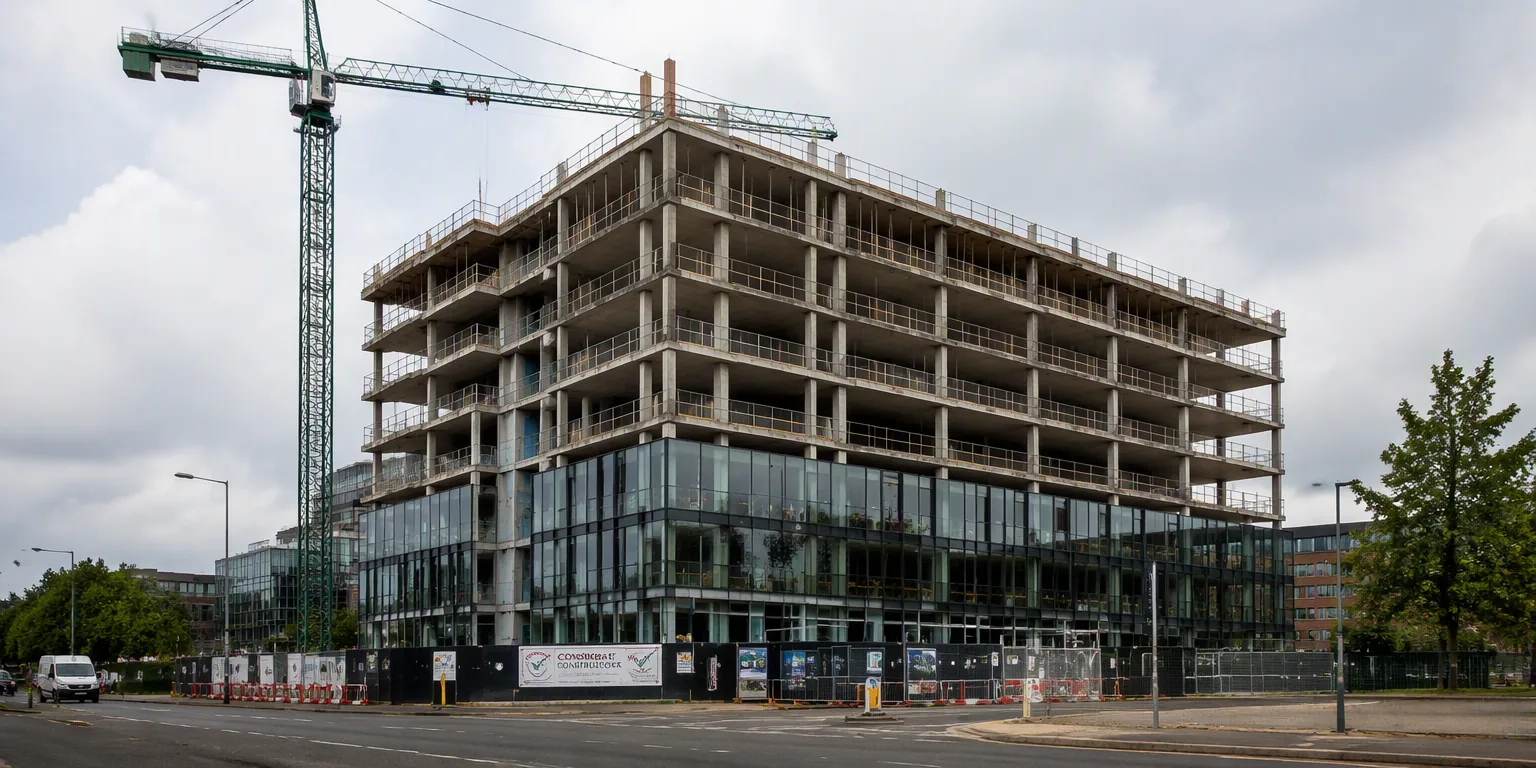
Procurement
Procurement strategy failure
The route was chosen for the programme. Everything that went wrong afterwards was a predictable consequence of that single decision.
The situation
A fixed price for a partially defined building
A developer selected a design and build route on a scheme where the design was not sufficiently developed to be novated with confidence. The reasoning was straightforward: single point responsibility, fixed price, a defensible number for the funder.
What they received was a fixed price for a partially defined building. Design responsibility transferred to a contractor who had not developed the design and who, understandably, developed it to the minimum standard the Employer's Requirements permitted. Meanwhile every clarification the client sought beyond that minimum became a variation.
Single point responsibility had been achieved. Cost certainty had not, because certainty depends on definition rather than on contract form.
What we found
The right route, selected against the wrong criterion
The route was not wrong in itself. Nevertheless it had been selected against the wrong criterion and implemented without the conditions it requires.
Employer's Requirements described the scheme in aspirational language in several places, which is fatal in a design and build contract because aspiration is unenforceable.
Novation occurred before the design team had produced information sufficient for the contractor to price the client's actual intent.
The contractor's proposals contained departures from the Employer's Requirements that had not been reviewed line by line. Consequently several departures became the contract position by acceptance.
The package structure placed the most uncertain scope with the party least able to influence it, which guarantees the risk returns as cost.
What changed
Choose the form to suit the state of the design
For this scheme the position was stabilised. The wider change was in method, applied to every phase that followed.
Review the proposals line by line
Every departure from the Employer's Requirements was identified and the material ones resolved commercially, before they became the contract position by acceptance.
Start route selection from design maturity
On subsequent phases the first question was how defined the design actually was. The contract form followed from that answer rather than preceding it.
Use two stage where definition is short
Where information was insufficient for full transfer, a two stage approach retained the client's influence during design development while still producing a contract sum before commitment.
Place uncertainty with the party who can influence it
Packages were restructured so that the most uncertain scope sat with whoever could actually affect the outcome, which is the only allocation that does not return as cost.
Why this happens
The earliest decision, taken when least is known
Procurement route is frequently decided by programme, by funder preference or by habit, and it is decided early. However, it determines every commercial position that follows, and it is very difficult to reverse.
Tendering and procurement treats route selection as a risk decision tested against the actual state of the design. In addition, cost planning and estimating establishes whether the information supports the transfer being contemplated before the client commits to it.
Questions
Asked about procurement routes
How do I choose between traditional and design and build?
By deciding what you most need to control. Traditional keeps design authorship with your team and gives you a measurable basis for valuing change, at the cost of carrying design risk. Design and build transfers development of the design and tends to fix the price earlier, at the cost of specification control and of expensive change once the contract is let. Neither route is safer in the abstract. The wrong route is the one chosen before anyone established which risk the scheme actually carries.
Is two stage procurement a way of avoiding competition?
It removes competition from the second stage, which is the point at which most of the cost is fixed, so it has to be managed deliberately. Two stage works where the contractor's early input genuinely reduces risk and where the second stage package is opened up, tested against market rates and audited line by line. It fails where the first stage is treated as an appointment and the second as a formality. The route is sound; the conversion is where value is won or lost.
When is it too late to change procurement route?
Practically, once tender documents have been issued, because the documents themselves are route-specific and reissuing costs programme. The decision therefore needs to be taken while the design is still being shaped for it, not after. Where a route is chosen late, the documents usually carry traces of the earlier assumption, and those traces become the ambiguities a contractor prices around. Reviewing route and documents together, before issue, is what prevents that.
Does a construction management route give better cost control?
It gives better visibility and worse certainty, which suits some clients and not others. Packages are let progressively at known prices, so you see the cost of each as it is committed, but you carry the risk of the packages not yet let and of the interfaces between them. Construction management rewards a client with an experienced commercial team and punishes one without. The question is not which route controls cost best, but which one your organisation is set up to run.
Can procurement strategy be revisited once works have started?
For remaining packages, sometimes, and it is worth examining where the original route is clearly not performing. What cannot be revisited is anything already committed, so the exercise is about limiting further exposure rather than recovering what has gone. Where this arises we look at the packages still to be let, the leverage still available and the contractual position of the existing appointment, then advise on what is realistically changeable and what is not.
Related scenarios
Where this connects
Choosing a route before the design is settled?
Tell us where the design has reached and what the funder needs. We will set out which forms the information actually supports.
Insights