
Where we work
Refurbishment and reuse
Existing fabric, unknown until opened up
In refurbishment the largest cost driver is the thing nobody has measured, which is the building that is already there. We provide independent quantity surveying services on refurbishment, conversion and reuse schemes across the UK, where the commercial position has to hold while the scope is still being discovered.
The starting position
You are pricing a building nobody has fully seen
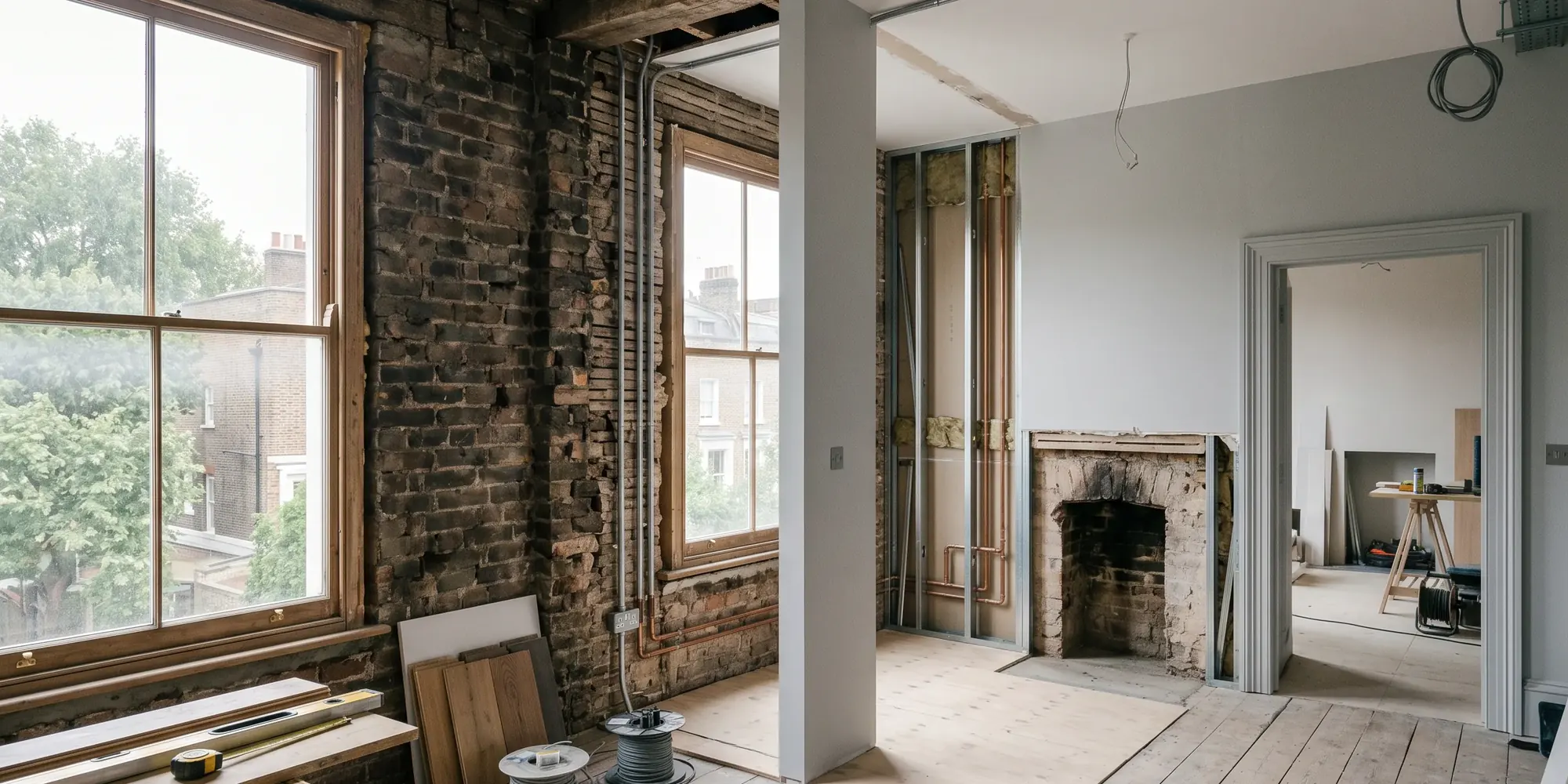
A new build scheme starts from a drawing. Everything in the cost plan corresponds to something a designer has decided. Refurbishment starts from a building that already exists, was built by people who are no longer available, has been altered by owners whose records are incomplete, and is concealed behind finishes that nobody is going to remove until the contractor is on site.
Structural condition, services capacity, asbestos, fire compartmentation, the actual line of a party wall, the true extent of previous alterations. Each stays unknown until the fabric is opened up, and each has the capacity to move the number materially rather than marginally.
That changes the commercial approach rather than the arithmetic. The question stops being how accurate the estimate is and becomes how the uncertainty is described, who carries it, and what happens contractually on the day it resolves.
The problem, and what we do about it
Four unknowns behind the finishes, and what each one costs to resolve
Almost every refurbishment overrun traces back to one of these four. None can be removed by better estimating. All of them shrink when survey work is commissioned early enough to reach the tender documents, because a risk that has been measured is bought in a competitive market and a risk that has not is bought from the contractor who already holds the job.
Structure nobody has drawn
Load paths that were never recorded, floors that will not take the new loading, lintels missing over openings formed informally, and slabs whose thickness is a matter of opinion until somebody cores one.
A structural appraisal with intrusive opening up is scheduled before tender wherever loads are changing, and the result is measured as work rather than carried as an allowance. Where the survey has not happened yet, the assumption we have priced is written on the face of the budget with a value attached, which tells you which survey to commission first.
Measured work instead of an open riskServices assumed to be reusable
Incoming capacity, riser space, plant room space and the condition of distribution being retained. Reuse decisions taken on a visual inspection have a habit of reversing once the system is tested under load, by which point the strip out is finished.
Retention is priced as a decision with two outcomes rather than as a saving. A services condition and capacity report resolves it before tender. Where it cannot, the cost of full replacement sits in the risk register as a named line, so the exposure is visible rather than absorbed into a contingency percentage.
Both outcomes priced before you commitHazardous material found mid works
Asbestos in locations a management survey was never intended to reach, along with lead, contaminated ground under a slab, and material only classified once it is removed. Discovery stops work in the area as well as costing money.
A refurbishment and demolition survey rather than a management survey, commissioned in time to inform the documents. Alongside it, an opening up protocol agreed before the contract: who opens up, when, in whose presence, what record is made and how the finding is valued. Agreed in advance it is administration. Equally, agreed afterwards it is a negotiation held under programme pressure.
A protocol instead of a negotiationCompliance triggered after the budget is fixed
Fire compartmentation, means of escape, acoustic separation and thermal performance. Whether an existing element has to be brought up to current standards is a regulatory judgement, and it frequently lands late.
The trigger points are identified with the design team at budget stage and each is carried as a priced option, not as a footnote. Where a building is listed or in a conservation area, conditions are tracked as cost lines with dates in the same way as any other third party approval, rather than treated as a planning matter sitting outside the cost plan.
A priced option, not a late surpriseHow we price it
Provisional sums defined tightly, not generously
A generous provisional sum feels prudent and behaves badly. It hands the contractor a budget rather than a scope, removes any competitive pressure on the work it covers, and makes the eventual expenditure almost impossible to challenge. A defined provisional sum does the opposite.
Separate the known from the assumed
Work that can be measured from a survey is measured and priced as measured work. Only the genuinely undiscoverable sits as a provisional sum, and it is listed rather than folded into an element.
Define the scope, the quantity and the trigger
A defined provisional sum states what the work is, how much of it is allowed for, and what evidence resolves it. The contractor prices programme and preliminaries around it, which is the whole point of defining it.
Set the opening up protocol before the contract
Who opens up, when, in whose presence, what record is made, and how the finding is valued. Agreed in advance it is an administrative step. By contrast, agreed after discovery it is a negotiation held under programme pressure.
Resolve each sum on evidence and close it
Provisional sums are instructed, valued and expended as the work is found, not carried to the final account as a block. Left open, they arrive together at the end with the site facts already covered up.
Where the money moves
Five things refurbishment does that new build does not
01Existing fabric changes the risk allocationWho carries the building nobody has surveyed
On a new build, ground conditions are the main pre-existing risk and the market has settled ways of allocating it. Equally, on a refurbishment the entire structure is a pre-existing condition, and the contract has to say who carries it before a price means anything.
A contractor asked to accept unqualified risk on an unsurveyed building either prices it heavily or qualifies the bid until the risk returns to the client without the client noticing. Both outcomes are worse than an explicit allocation supported by survey information, because both are invisible in the tender total.
Where a bid carries qualifications, they are the most important part of the document. Normalising them so that bids can be compared on the same basis is part of tendering and procurement rather than an administrative afterthought.
02Measurement of what stays, goes and is made goodThree quantities, not one
A refurbishment schedule has to describe three separate things for every element: what is removed, what is retained, and what is done to the junction between them. Making good is where refurbishment quantities are lost, because it is easy to describe loosely and expensive to execute.
Strip out is measured as work in its own right, with its disposal, its protection requirements and its sequencing, rather than treated as a lump sum at the front of the programme. Where a building is occupied or partly occupied, protection and out of hours working are quantities too.
03Preliminaries behave differentlyAccess, storage and the crane you cannot put anywhere
A refurbishment site usually has no compound, no storage, restricted access, a scaffold that has to be tied into fabric of unknown condition, and neighbours close enough to constrain working hours. None of that is captured by taking preliminaries as a percentage of the works.
Time is the driver. Where the sequence forces trades to work in small areas, return to completed zones, or wait for opening up results, the preliminaries cost rises without any change to the measured work. Pricing that honestly at tender stage is cheaper than arguing about it at valuation twelve.
04Listed buildings and planning constraintSpecification set by consent rather than by choice
Where a building is listed or sits in a conservation area, the specification is partly written by the consent. Like for like repair, specified materials, specialist trades, sample panels and approval periods each carry cost and, more significantly, carry time.
The commercial risk is that a condition is discharged late and changes an item that has already been priced. Conditions are tracked as cost lines with dates against them, in the same way as any other third party approval, rather than treated as a planning matter that sits outside the cost plan.
05Change arrives as discovery, not as decisionValued while the evidence is still visible
On most schemes a variation follows a decision somebody took. By contrast, on a refurbishment the majority follow something that was found. Discovery has a habit of stopping work in the area concerned, which means the valuation argument and the delay argument arrive together.
Records made at the moment of discovery decide both. A photograph, a dated record of what was exposed, a measured note and an instruction issued before the work is covered up are worth more later than any amount of retrospective reasoning. Monthly discipline under cost control and variations is what produces them.
Scope of an instruction
What we issue on a refurbishment scheme
A full appointment covers all of the below. Most refurbishment instructions begin with the survey schedule, because the sequence in which information arrives determines what can be priced as measured work and what has to sit as risk. Scope and the side we act for are confirmed in writing before anything starts.
Budgets built from condition information, with survey gaps listed as stated assumptions
A survey schedule identifying what has to be commissioned, and by when, to reach tender
Measured quantities covering strip out, retained fabric and making good as separate work
Defined provisional sums with scope, quantity and the evidence that resolves each one
Tender documentation with an explicit risk allocation for pre-existing conditions
Monthly reporting that tracks provisional sum expenditure against allowance, item by item
Questions
Asked on refurbishment schemes
How much contingency does a refurbishment need?
We do not publish a percentage, because a percentage carries no information about your building. Contingency should be built from a risk register with named items, each with a probability and a value, so that the total can be explained and so that it reduces as surveys resolve individual lines. A single figure taken from convention cannot do either.
Is it cheaper to refurbish or to demolish and rebuild?
It depends on the condition of what is there, on planning constraint, on programme and increasingly on embodied carbon obligations. The honest answer at feasibility is that both options need pricing on the same basis, including the risk allowances, before either is discounted. A comparison that prices new build from measurement and refurbishment from a rate is not a comparison.
What surveys should we commission before tender?
As a minimum, a structural appraisal with intrusive opening up where loads are changing, a refurbishment and demolition asbestos survey rather than a management survey, a services condition and capacity report, and a drainage survey. Which of those is critical depends on the scheme, and the sequence matters as much as the list.
Can you price a scheme before the surveys are back?
Yes, provided the assumptions are stated on the face of the document with a value attached to each. A budget that hides the assumptions inside an average reads as more certain than it is, which is the failure mode we are trying to avoid. Stating them also tells you which survey to commission first.
Should the contractor be appointed early to help price the risk?
Two stage procurement suits refurbishment, because a contractor brought in during the second stage can carry out opening up before the price is fixed. The cost of it is that the second stage price is negotiated rather than competed, so the preliminaries, overhead and profit percentages have to be fixed competitively at the first stage or the advantage is lost.
Do you act for lenders on refurbishment schemes?
Yes, under development monitoring surveying, where the pre-existing condition risk is usually the first thing a facility needs to understand. We do not act for a lender and a developer on the same scheme, in either order.
Where to go next
Related work
Insights