
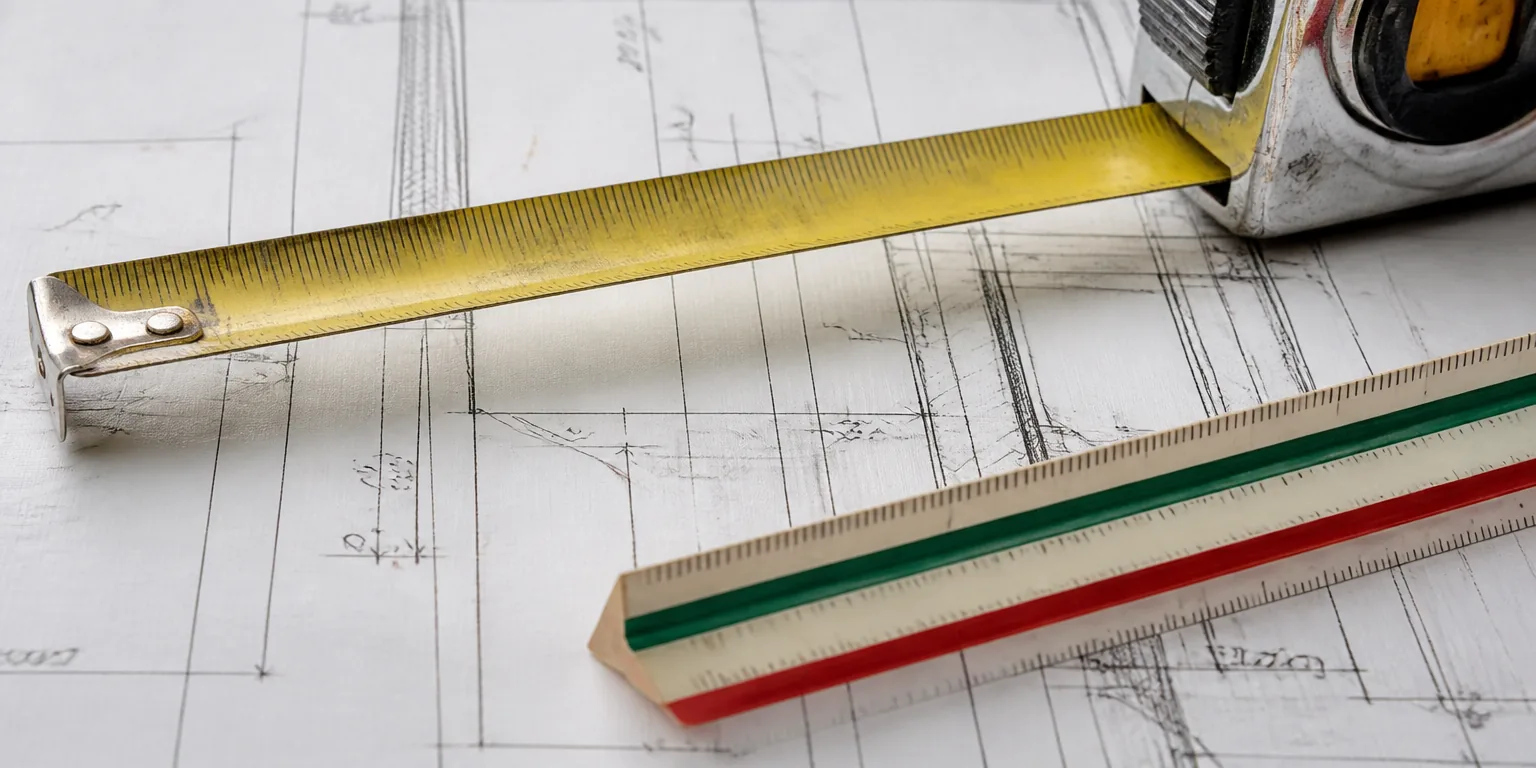
NRM2 measurement is the rule set that governs how building work is quantified and described in the United Kingdom. It sits within the RICS New Rules of Measurement, alongside NRM1 for cost planning and NRM3 for maintenance, and it applies at the point a scheme is being priced in detail.
A developer does not need to be able to apply it. What is worth understanding is what it decides, because those decisions determine what a contractor can charge for, what has to be included in a rate, and what counts as a change once the contract is signed.
What a measurement standard actually does
Two people measuring the same wall can arrive at different quantities, both correctly, if they are working to different conventions. Does the area deduct openings below a certain size. And does it measure to the centre line or the face. Is the work described by area, by length, or by number.
A measurement standard removes that ambiguity by fixing the conventions in advance. Everybody measures the same way, so quantities from different sources are comparable and a tender comparison means something.
It also fixes what each item includes without saying so. A rate for a given item of work carries a defined list of things deemed included, and a contractor cannot later claim for those separately. That is where the commercial significance sits.
Deemed included, the part that matters commercially
Under NRM2 each measured item carries a coverage rule stating what the rate is deemed to include. Labour, plant, waste, laps, fixings and a range of incidental operations are typically covered without appearing anywhere in the description.
This protects the client. Where a contractor prices an item, they are pricing everything the rule says is included, whether or not they thought about it. An argument later that a particular operation was not in the price fails if the standard says the rate covers it.
It protects the contractor too. Anything not covered by the rule, and not separately measured, has not been priced, and a client asking for it is asking for a variation. Both parties therefore benefit from a bill that states the standard it was prepared to.
The pieces developers meet most often
Provisional sums appear where work is known to be needed but cannot yet be measured. NRM2 distinguishes between defined and undefined sums, and the distinction has real consequences for programme and preliminaries entitlement.
Prime cost sums cover work by a supplier or specialist selected later. Approximate quantities are measured items whose quantity is expected to change and which will be remeasured. Dayworks cover work that cannot sensibly be valued by measurement at all.
Each of these is a legitimate device and each is also a place where risk quietly transfers. A bill with a large proportion of its value in provisional sums is not a priced document, it is an estimate with a contract attached, and it should be read that way.
Measured work and the drawings behind it
Quantities are measured from drawings, and their quality cannot exceed the quality of the drawings. Where the design is incomplete, the measurement either has to make assumptions or has to leave items as provisional.
Assumptions made during measurement should be recorded and issued with the quantities. A schedule of assumptions turns an invisible judgement into a visible one, and it lets the design team correct anything that is wrong before it becomes a variation.
Where quantities arrive with no such schedule, the assumptions still exist, they are simply not written down. That situation is the subject of quantity assumption risk.
Who measures, and why it matters who
On a traditional procurement the client's quantity surveyor prepares the bill and the contractor prices it. The quantities are the client's and any error in them is the client's risk. On design and build the contractor usually measures their own work, and the quantity risk sits with them.
Neither arrangement is inherently better, but they produce different behaviour. Where the contractor carries the quantity risk they will price for the uncertainty, and the price of that uncertainty is invisible in the total. Wherever the client carries it, errors surface later as adjustments.
Understanding which arrangement you are in is the first step in reading a tender. Our approach to preparing and checking quantities is set out under quantities and take-off.
Where NRM2 stops
A measurement standard governs how work is quantified and described. It does not decide what the work should be, whether the design is buildable, whether the specification is appropriate, or whether the rate applied is reasonable.
It also does not govern the contract. Valuation rules, payment mechanisms and change procedures sit in the building contract, and a bill prepared to NRM2 can be used with any of the standard forms. Confusing the two is common and leads to arguments that cite the wrong document.
On residential schemes with repeated unit types, the interaction between measurement and design change is particularly sharp, and is set out under residential development.
What this means for you
Ask what standard your quantities were prepared to, and ask for the schedule of assumptions. Those two questions tell you most of what you need to know about how much weight the document will bear.
If the answer is that no standard was stated, treat the quantities as an estimate rather than a measurement. They may still be useful, but they will not settle an argument, and settling arguments is most of what a bill of quantities exists to do.
Want a second opinion on quantities you have been given?
Send the drawing set and the bill or schedule. We will tell you what the quantities assume and where the risk sits.