
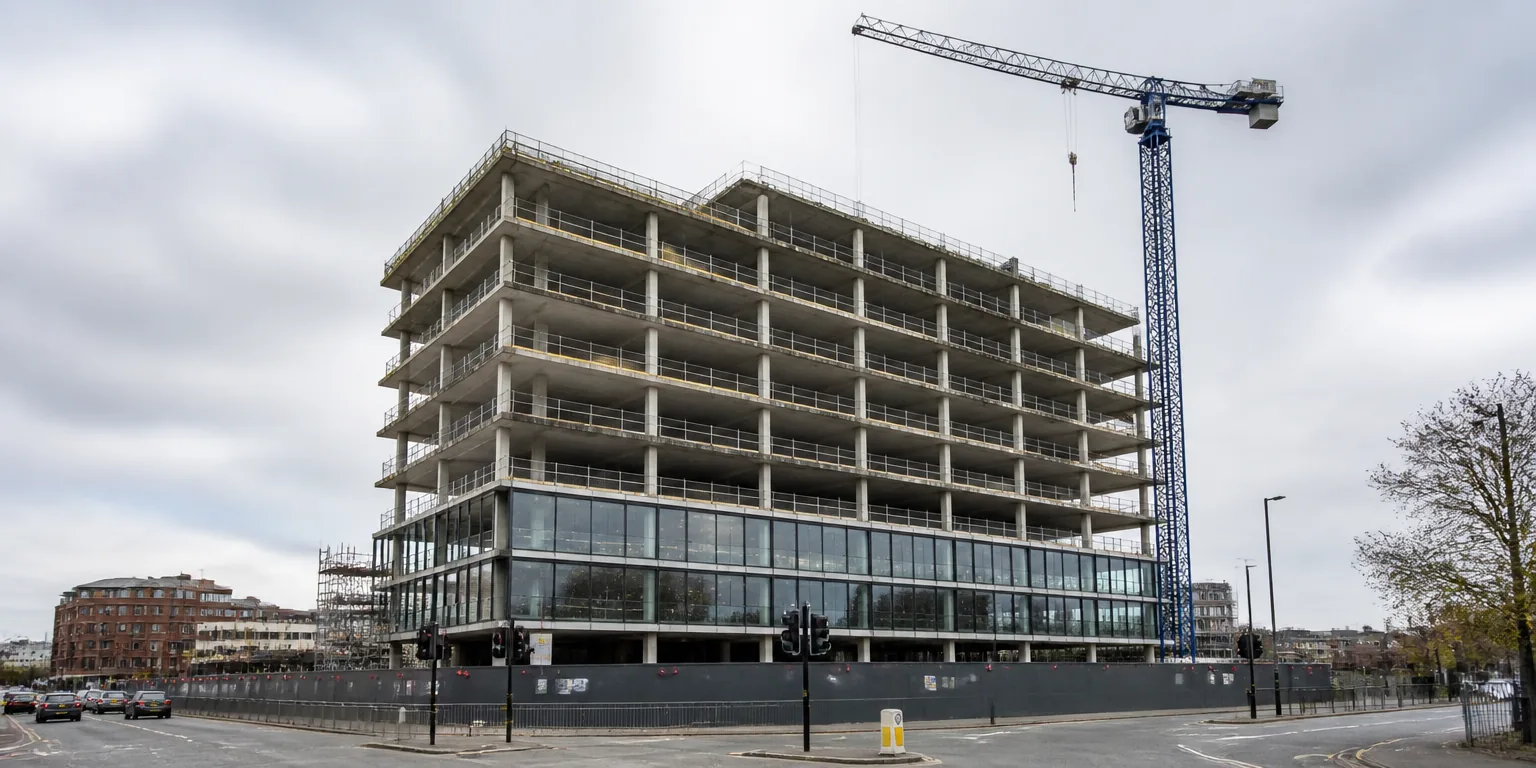
An initial appraisal report is produced before a development facility advances anything. Its purpose is to tell the lender whether the scheme as proposed can be built for the money available, on the programme stated, by the team assembled.
It is also the last moment at which conditions can be attached without argument, because the borrower still needs something. Every protection secured here costs nothing; the same protection sought at drawdown eight is a negotiation.
Cost, and whether the plan is real
The cost plan is reviewed for structure as much as for total. Is it built from measurement or from rates. Are abnormals and external works separated. Is inflation stated to a date. Equally, is the risk allowance built from a register or taken as a percentage.
A plan that cannot answer those questions is not necessarily wrong, but it cannot be tested, and a number that cannot be tested is not a basis for lending.
Costs outside the building contract get particular attention, because they are frequently understated and they are the borrower's responsibility to fund. Fees, statutory payments, utilities, finance and the client's own costs are all in scope.
Programme, and what it assumes
The programme is reviewed for realism and for the assumptions underneath it. Start on site dates conditional on discharging planning conditions. Long lead items ordered on time. Seasonal work in the right season.
The critical path matters to a lender because delay costs interest and can run a facility past its term. A programme with no float and several dependencies outside the contractor's control is a programme with a problem.
Where the programme and the cost plan assume different durations, that discrepancy is itself a finding and it is more common than it should be.
Contract and procurement
Which form, which amendments, what is fixed and what is not. A design and build contract on a complete Employer's Requirements is a different proposition from the same form on a thin one.
The proportion of value sitting in provisional sums tells the lender how much of the fixed price is actually fixed. A high proportion of undefined sums means both cost and programme risk remain open.
Contractor covenant, bonding and warranties come in here too, along with whether the security package the lender requires has actually been put in place rather than agreed in principle.
The team and the consents
Who has been appointed, on what terms, with what professional indemnity cover, and whether collateral warranties in favour of the lender exist. A design team appointed without warranties is a gap that is easy to close now and impossible later.
Planning consent, its conditions, and which of them are pre commencement. A pre commencement condition not yet discharged is a start date that has not been secured.
Building control, statutory approvals, party wall matters, rights of light and any section agreements. Each has a timescale that the construction programme cannot compress.
The conditions schedule
The most valuable output is usually not the narrative but the list of conditions to be satisfied before first drawdown, and the list of matters to be monitored thereafter.
Conditions typically cover the security package, outstanding appointments and warranties, undischarged planning conditions, evidence of equity, and any survey work the appraisal has identified as necessary.
Those conditions are the cheapest protection in the whole facility. They are also the ones most likely to be traded away under time pressure, which is a decision the credit team should take consciously rather than by default.
Saying the unwelcome thing
Sometimes the honest conclusion is that the facility plus the borrower's equity does not complete the building on realistic assumptions. Saying that at appraisal is unpopular and it is the entire reason for the appointment.
The alternative is discovering it once the lender is committed, at which point the borrower's negotiating position has improved considerably and the options have narrowed to more money or a stalled site.
That requires independence to be structural rather than a matter of intention. We do not act for a borrower and a lender on the same scheme in either order, and the position is set out under what we do for the lender side.
What this means for you
Read the conditions schedule first. The narrative describes the scheme; the conditions describe what the lender should insist on while they still can.
Then check whether the report tests cost to complete on realistic assumptions rather than accepting the borrower's budget. That distinction is the whole value of the exercise, and it is set out in cost to complete.
Need a scheme appraised before first drawdown?
Send the cost plan, the programme, the contract and the planning position. We will report on whether the proposition completes.